
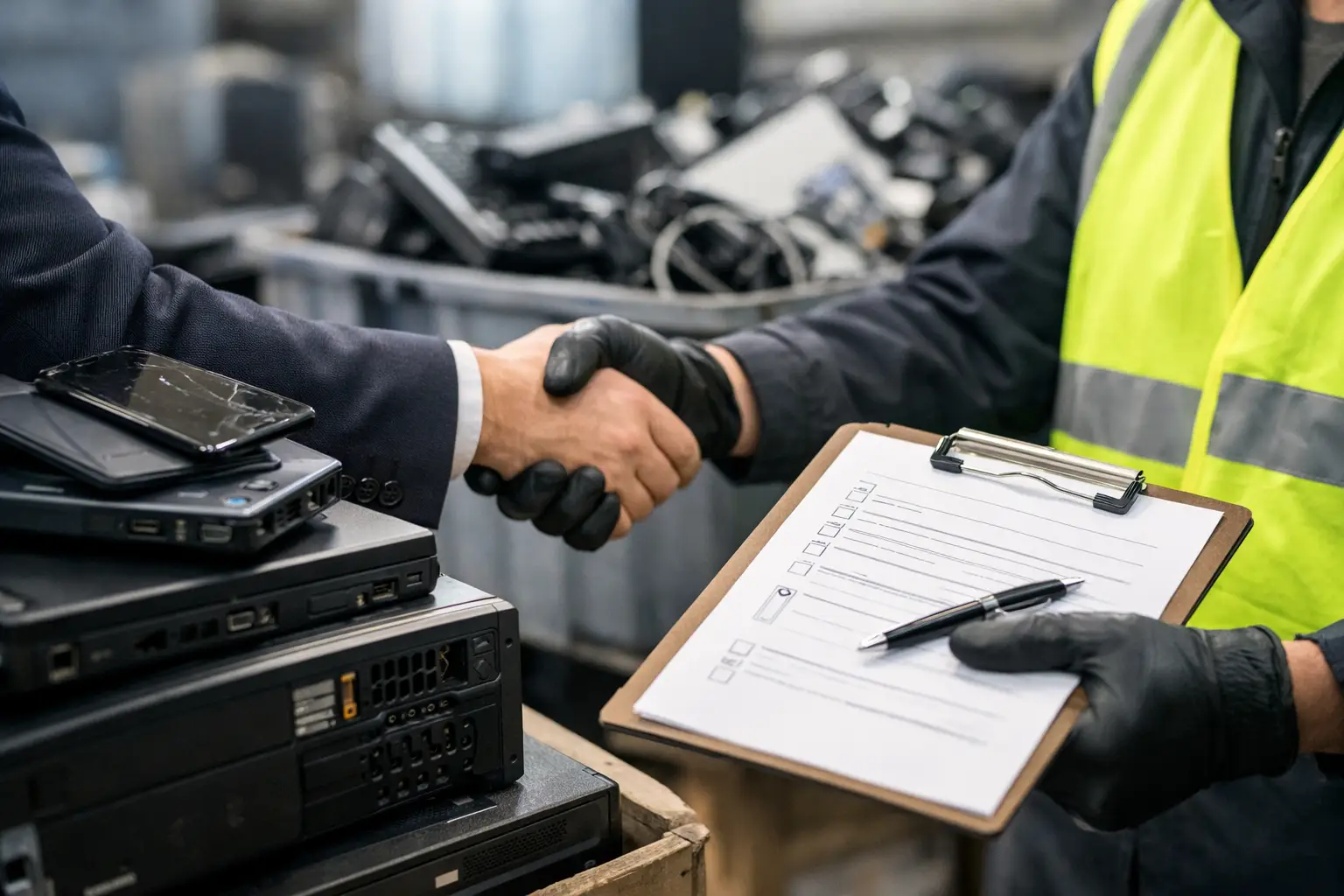
When old laptops, office PCs, phones, or servers leave your home or workplace, the risk does not end at the door. That moment of handover matters. Proof of collection for IT disposal gives you a documented record that your equipment was picked up, when it was picked up, and who took responsibility for it. For households, that means peace of mind. For businesses, it adds a layer of accountability that is hard to ignore when devices may still contain sensitive data.
A lot of people only think about disposal in terms of clearing space. The bigger issue is control. If equipment disappears into an informal collection chain with no paperwork, no item verification, and no record of transfer, you are left trusting a process you cannot see. That is exactly why documented pickup matters.
What proof of collection for IT disposal actually means
Proof of collection for IT disposal is a written or digital record confirming that your unwanted electronic equipment was collected by a service provider. In practical terms, it usually includes the pickup date, location, a description of the items collected, and the party handling the collection.
That may sound simple, but it serves an important purpose. It creates a checkpoint between you and the next stage of recycling, data wiping, refurbishment, or downstream processing. Without that checkpoint, there is no clear trail showing when your equipment left your control.
For a homeowner disposing of a few old devices, this record helps confirm that the handover happened properly. For an office manager clearing storerooms or replacing company hardware, it becomes part of a more disciplined disposal process. If someone later asks what happened to the retired devices, there is something concrete to refer to.
Why documented pickup matters more than people expect
The main value of proof of collection is accountability. If a collector arrives, loads up your equipment, and leaves with nothing more than a verbal assurance, you are relying on memory and trust alone. That may feel fine in the moment, but it becomes a problem if you need to verify what was collected or when it happened.
This is especially relevant for IT assets. Computers, hard drives, servers, and network equipment are not just physical items. They can hold client records, employee data, financial files, saved passwords, and internal business information. Even a family laptop can contain years of personal documents and photos.
A documented pickup does not replace proper data destruction, but it supports the chain of responsibility. It shows that the disposal process started in a controlled and recorded way. That matters if you are trying to avoid careless handling or informal resale routes.
There is also a practical side. Businesses often need internal records for asset write-offs, office relocation cleanouts, hardware refresh projects, or compliance reporting. A pickup record helps admin teams, IT teams, and management stay aligned. It reduces confusion over whether items were actually removed, and which items were included.
What should be included in proof of collection for IT disposal
Not all pickup records are equally useful. A vague note saying electronics were collected is better than nothing, but it may not be enough if you are disposing of multiple assets or handling equipment with storage media.
A solid proof of collection for IT disposal should clearly identify the collection date and location, the service provider, and the general types or quantities of equipment taken. In some cases, especially for business collections, more detailed asset verification may be appropriate. That depends on the size of the pickup and how much visibility the customer needs.
If you are disposing of a few household devices, broad descriptions may be enough. If you are clearing ten desktops, three servers, and several hard drives from an office, a more itemized record is often the better choice. The right level of detail depends on risk, volume, and how the record will be used later.
Households need reassurance too
It is easy to assume this kind of documentation only matters to companies, but households benefit from it as well. Many personal devices contain far more sensitive information than people realize. Old smartphones, tablets, laptops, and external drives can hold banking apps, identity documents, tax files, and personal messages.
When a pickup service provides a record of collection, it shows a more professional approach from the start. It signals that the provider is not treating your devices like anonymous scrap. That difference matters when you are handing over electronics that may still have private data on them.
For families clearing out old devices during a move, renovation, or spring clean, documented pickup also removes uncertainty. You know the items were collected, and you have a record to keep if needed. That is a much better position than wondering whether the devices ended up in the right hands.
Businesses have more at stake
For businesses, the stakes are usually higher. Even small companies can have sensitive data spread across desktops, laptops, point-of-sale systems, backup drives, printers, and network hardware. When those assets are retired, disposal becomes part of risk management.
Proof of collection supports that process in a straightforward way. It helps establish when equipment left the premises and who collected it. That may support internal asset tracking, offboarding of obsolete equipment, audit preparation, or simple operational clarity.
It is not the same as a full certificate of destruction or a detailed IT asset disposition report. Those documents serve different purposes. But proof of collection is often the first formal record in the disposal chain, and it should not be skipped.
If your business has compliance needs or stricter internal controls, you may need more than a collection note. Still, even in those cases, pickup documentation remains a basic and necessary step.
Proof of collection is only one part of a safe disposal process
A common mistake is assuming that a pickup record alone guarantees secure disposal. It does not. It confirms collection, but it does not automatically prove that data was wiped, drives were destroyed, or equipment was processed by the right downstream recycler.
That is why the disposal service itself matters. The strongest approach combines proof of collection with IT-aware handling, secure data wiping where applicable, hard drive destruction support when required, and responsible coordination for downstream recycling.
This is where informal collectors often fall short. They may be fast and cheap, but they rarely offer meaningful documentation or a process designed around data protection. If the devices involved are low value but high risk, that trade-off can be a poor one.
A professional service should be able to explain what happens at pickup, what records are provided, and what follows after collection. Clear communication is a good sign. Vague answers usually are not.
When a basic pickup record may not be enough
There are situations where proof of collection for IT disposal should be paired with additional documentation. If your business is retiring a larger batch of equipment, disposing of storage-heavy devices, or handling client-sensitive systems, you may want item verification and records tied to serial numbers or asset tags.
If data destruction is part of the service, ask how that is documented separately. A pickup record confirms transfer. A data wiping report or destruction confirmation addresses what happened to the data-bearing devices afterward. Those are related, but they are not interchangeable.
For households, the need is usually simpler, but the same principle applies. If you are especially concerned about data on an old laptop or hard drive, the best protection is not just a collection record. It is a collection record supported by secure handling and proper data sanitization.
Choosing a provider that takes documentation seriously
If you are arranging an electronics pickup, ask one basic question before collection day: what documentation will I receive? The answer tells you a lot about how the provider operates.
A service that offers documented pickup is usually working with a more accountable process. That does not mean every provider uses the same format or level of detail, but it does show they understand that disposal is not just about removing clutter. It is about transferring responsibility properly.
For customers in Kuala Lumpur and Selangor, this is one of the reasons a service-focused provider like MYPC2U can offer a stronger alternative to generic scrap collection. The pickup is not treated as a casual removal job. It is handled as part of a secure and documented disposal process built around real IT concerns.
That difference matters most when the devices being removed once carried personal files, business records, or operational data. A clear pickup record helps close the gap between trust and proof.
If you are planning to dispose of old electronics, think beyond getting them out of the way. The right question is not just who can collect them. It is who can collect them responsibly, with a record you can keep.


Leave a Reply